


 Course Duration
 Participants
 Investment
 What is the Bertelsmann Scholarship Initiative?
Bertelsmann is investing significantly in scholarships, with an exclusive focus on our employees. The program helps learners from all Bertelsmann divisions all over the world become future-ready by developing relevant skills and fostering both personal and professional growth.
Through learning opportunities from Coursera, Udacity and Harvard Online, participants can build future-ready skills in AI Fluency & Transformation, Agentic AI, AI Engineering, Product Management, AI Security and other future-relevant topics.
What´s new this time?
This year's scholarship program comes with exciting new learning opportunities designed to help employees build future-ready skills in the age of AI.
Participants can explore new learning experiences with our trusted learning partners Coursera, Udacity and Harvard Online. New content offerings include Agentic AI Foundations from Harvard Online, updated Udacity Nanodegrees in areas such as Agentic AI, AI Engineering, Product Management and AI Security as well as a broad course range on Coursera.
For Coursera participants, a personal Copilot AI agent has been developed to make learning more personalized and skills-based. The agent helps participants identify their individual learning needs and find relevant learning content in AI Fluency and Transformation, enabling a more targeted approach to personal development.
Bertelsmann Scholarship Overview
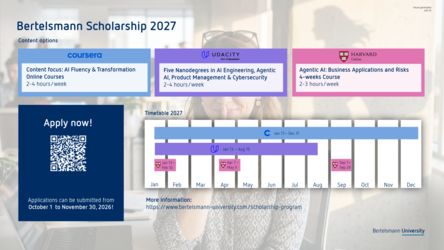
How to apply?
Applications are open to all employees from October 1 - November 30, 2026 (on this landing page). All you will need to do is:
- Choose if you would like to learn with Coursera, Udacity or Harvard Online (if Udacity, please also choose your preferred Nanodegree)
- Enter some backround information
- Answer a few short questions about your motivation, your day-to-day work and how you use AI.
Please note that each employee can only take up one seat at a time.
These are our learning partners!

Seats: 1,500
Content: AI Fluency and Transformation.
Your Coursera scholarship includes 12 months of full access to the Coursera platform, offering a wide range of courses, Professional Certificates and learning programs from leading universities and industry partners. In addition, a personal AI agent supports you throughout your AI Fluency and Transformation learning journey with personalized, skill-based guidance.
More about learning with Coursera

Seats: 400
Content: AI Engineering, Agentic AI, AI Security & Product Management
You can choose from a defined set of 5 Nanodegrees that follow learning paths which are in line with some of the most in-demand skills profiles across the Bertelsphere. Please see more information about this year´s Nanodegrees below:
// AI Programming with Python Beginner
// Microsoft Agentic AI Intermediate
// Anthropic Engineer Intermediate
Seats: 250
Content: Agentic AI
As part of a cohort of fellow Bertelsmann employees, you will complete the 4-week Agentic AI: Business Applications and Risks program. You will learn how AI agents work, how they can support business tasks and workflows, and what opportunities, risks and governance requirements need to be considered when using them.
You will explore practical business applications of agentic AI while building a solid understanding of how to use AI agents responsibly and effectively in your professional environment.

Apply now!
Choose your learning provider and get started.
General FAQ
Info & FAQ session for employees
We are offering an information session for all interested Bertelsmann employees on October 8, 2026, at 4:00 PM (CEST). Join us to learn more about the program and application process and to get your questions answered. You can access the session via the following link: MS Teams.
What is the Scholarship Initiative?
Bertelsmann is investing significantly in scholarships, with an exclusive focus on our employees. The program helps learners from all Bertelsmann divisions all over the world become future-ready by developing relevant skills and fostering both personal and professional growth. Employees get to choose between 3 different content providers according to their learning or content preferences:
- Coursera: AI Fluency & Transformation enabled by a personal AI agent for targeted skill-based learning
- Udacity: AI Engineering, Agentic AI, Product Management & Cybersecurity Nanodegrees
- Harvard Online: Agentic AI: Business Applications and Risks
We encourage all learners to involve their manager and/or HR in their choice of content in order to make their upskilling commitment visible and explore suitable development steps to accompany their learning journey. Once accepted into the program, employees can start working towards their certificate without any further funneling process besides the activation deadlines.
How many seats are available?
Each year, we are offering the following seats to interested employees:
- Coursera: 1,500
- Udacity: 400
- HBS: 250
How many hours a week should students expect to spend?
- Coursera: 2-4 hours/ week
- Udacity: 4-6 hours/ week
- Harvard Online: 2-3 hours/ week
Does the learning time count as working time?
We recommend a model of shared responsibility: 50% of the learning time may be completed during working hours, while the remaining 50% should be invested outside of work as personal study time.
What is the program language?
The program language for courses with all providers is English. English subtitles are available and some Coursera courses are also available in additional languages.
When does the application period take place?
Applications open on October 1, 2026 and close on November 30, 2026.
Where can Bertelsmann employees apply for the Scholarship Program?
The application must be submitted proactively on this landing page. Interested employees can go to the top of this page and directly choose the preferred provider.
Who can apply?
All Bertelsmann employees, who want to learn future-ready skills and are at least 18 years old. All necessary prerequisites are explained in the descriptions of each content provider.
What information is requested in the application?
First, learners must choose the learning provider they would like to apply for. Each application form is structured into different parts:
- Background information/ personal data → Learners should be prepared to enter their Levio ID
- Short motivational question
What are the criteria for being selected?
- Seats will be divided among divisions and according to diversity criteria (e.g. division & demographics)
- Answers to motivational questions
Is it possible to apply for more than one content provider?
Each employee can only take up one seat at a time. Learners should choose the learning provider that suits them best.
Can I apply even though I already participated last year?
Yes. Participants can apply again for the same or another provider.
Why is it important to enter the Levio ID during the application process and how can learners find it?
We will record learner participation in Levio. HR departments view their scholarship participants through Levio. The employee ID is only relevant during the application phase and does not have to be re-entered, later.
Completion of the program and individual courses will also be uploaded on Levio and can be found in the respective Levio learning history.
The employee ID can be found on Levio under “My Employee Files”. If the employee ID is already required for logging in (no identity management), students should contact their local HR department.
Can I also apply when my company does not use Levio?
Yes. Simply enter your company and division name and register with your company email address so we can identify you as a Bertelsmann employee.
What learning provider and content can participants choose from?
Learners can apply for three different learning provider: Coursera, Udacity or Harvard Online
Coursera: Learners get access to the learning catalog and if they prefer a little more guidance, they can choose one of the pre-curated learning paths for mission critical tech & data roles and human-centric skills.
Udacity: Learners have to choose one out of 5 Nanodegrees.
Harvard Online: Learners get acces to the 4-week Agentic AI: Business Applications and Risks program.
Find more information in the Provider FAQ section
Who is shouldering the costs?
Bertelsmann is funding the scholarship to build some of the most in-demand tech & human skills of our time and covers the costs from a central budget.
As an employee, you only need to invest your time. We recommend a model of shared responsibility: Organizations invest 50% of working time and employees co-invest 50% of their personal time.
When do classes start? When will the results be announced?
Application Phase:
October 1 – November 30, 2026
Coursera:
January 13, 2027 – December 31, 2027
Udacity:
January 13, 2027 – August 15, 2027
Harvard Online (tbd):
Group 1: January 13 – February 10, 2027
Group 2: April 7 - May 5, 2027
Group 3: September 1 – September 29, 2027
Where does the program take place?
The program takes place 100% online. Students can work from wherever they want to, as long as they have a working internet connection.
What are the general technical requirements for participating in this program?
The learning content is extensive and requires a desktop computer. Udacity’s general technical requirements are listed here: www.udacity.com/tech-requirements. Coursera also offers a mobile app.
How do students retain their seat in the program?
Learners should make sure to make continuous learning progress. Bertelsmann University reserves the right to remove inactive users from the program in order to give as many employees as possible the chance to take part in this learning initiative. Learners will be informed in advance and given the chance to activate their license in time.
Coursera: There are two activation deadlines.
February 28, 2027: Learners should have started at least one course.
June 30, 2027: Learners who have not completed at least one course by this date risk being removed from the program.
Udacity: There are two activation deadlines.
By February 28, 2027: Learners should have started with their Nanodegree Program.
By April 15, 2027: Learners who have not completed at least the first project by this date risk being removed from the program.
Harvard Online: Learners should create a Harvard Online account and enroll in the course within the deadline announced by e-mail.
Can students withdraw/postpone studying after they got selected?
Employees should only join this program if they are committed to learning and graduating within the defined timeline of the program. Nevertheless, if they are no longer able to learn (especially as a Coursera license holder), students should inform Bertelsmann University (university@bertelsmann.com).
What information will HR receive about the participants during the process?
Bertelsmann University will assign the participation to learners’ training plans in Levio in the beginning of 2027 and update the learning history shortly after the end of course. HR departments will therefore have access to the names of participants in their specific units via Levio.
Please see data protection note here: Coursera/ Udacity/ Harvard
Need more infos?
You can find more detailed information at our comprehensive Info & Marketing page: https://www.bertelsmann-university.com/scholarship-program/scholarship-infos.html
This page is mainly designed for all divisional and local HR and communication departments to adjust the material for their needs and inform their employees about this initiaitve.
You are not (yet) a Bertelsmann employee and interested in the program?
The Bertelsmann scholarship is exclusively for Bertelsmann employees.
If you are interested in becoming a Bertelsmann employee, please visit: https://createyourowncareer.de/
Provider FAQ: Coursera, Udacity, Harvard Online
What learning content can participants expect with Coursera?
- A personal AI agent that guides each participant’s learning journey in AI Fluency and Transformation.
- In addition, participants receive 12-months unlimited access to all learning content on the Coursera platform (this excludes Master's and Bachelor's degree programs and some exclusive courses).
- Access to a wide range of courses, skillsets, specializations and clips designed by Coursera in collaboration with more than 200 universities.
- Extensive course catalog on many different topics with a focus on technology, business & future ready skills.
- CompleteCoursera catalog preview: here.
When does the Coursera Scholarship take place?
- Start: January 13, 2027
- Activation Deadlines / inactive user revoking: February 28 & June 30, 2027
- End: December 31, 2027
Why learn with Coursera?
- Coursera provides content in collaboration with some of the world's leading universities and institutions.
- Benefit from a personal AI agent that guides the individual learning journey.
- Coursera ownsa broadcourseportfoliothatenablestailoredlearningbasedon eachlearner’s needs.
- Highest possible flexibility: learning any time and from any place at the learner’s individual pace.
- Certificates of completion are issued by the institution that provides the content on the Coursera platform: a fast-track opportunity to obtain a sharable certificate from a top league university or renowned organization.
What does the learning journey with Coursera look like?
- Individual skill reflection guided by a personal AI agent, with targeted course recommendations tailored to individual needs.
- Courses include video lectures, assignments, peer learning
- 1-year self guided.
- Participants can learn in their own time.
- No specific class hours.
How can participants identify the right learning topics for their development?
For the first time this year, each participant’s learning journey will be supported by a personal AI agent. At the start, a short, guided dialogue helps participants reflect on their AI user profile, current skills, and development priorities. Participants then receive an individual report summarizing the results. Based on this reflection, the AI agent recommends relevant skills and learning areas tailored to each participant’s needs. At the end of the learning journey, participants repeat the skill reflection to assess their progress and individual skill development.
How long will each Coursera course take?
- Duration of the courses depends on the format and content and may range from 1 hour for nugget sized learning to around 100 hours for a specialized course.
- Courses are made up of short lectures and lessons - with only a few minutes each - so learners can make meaningful progress in just a few minutes a day.
- Coursera courses have been designed to allow learners to work at their own pace with bite-sized sessions and a self-paced learning model.
How do students retain their seat in the Coursera program?
Participants should make sure to use their license actively. Bertelsmann University reserves the right to revoke the licenses of any inactive users to give as many employees as possible the chance to take part in this initiative. Learners will be informed in advance and given the chance to continue learning, accordingly. The following program milestones apply:
- By February 28, 2027: Learners should have started at least one course.
- By June 30, 2027: Learners who have not completed at least one course by this date risk being removed from the program.
Do students get a certificate when studying with Coursera?
Upon completion of a course, learners will be eligible to receive a shareable electronic course certificate. Certificates of completion are issued by the institution that is providing the content on the Coursera platform: a fast-track opportunity to obtain degree from a top league university or renowned tech organization.
Do learners get a digital badge when studying with Coursera?
Learners will receive a Scholarship Recipient Badge once they have been accepted into the program. This badge can also be shared on social media.
What learning content can participants choose from with Udacity?
Employees can choose from a defined set of Nanodegrees which are in line with some of the most in demand skills profiles across the Bertelsphere. Each year, we are shaking things up a little and offer a variety of Nanodegrees to choose from. Employees need to indicate their chosen Nanodegree in their application. For the upcoming round, employees can choose between the following Nanodegrees:
- Product Manager (Beginner)/ Updated June
- AI Programming with Python (Beginner)/ Updated June
- Microsoft Agentic AI (Intermediate)/ Brand new
- Anthropic Engineer (Intermediate)/ Brand new
- AI Security Engineer (Intermediate)/ Brand new
When does the Udacity Scholarship take place?
- Start: January 13, 2027
- Activation Deadline: February 28, 2027 & April 15, 2027
- End: August 15, 2027
Why learn with Udacity?
- Students benefit from interaction and exchange with the community.
- Job-related projects by industry experts.
- Focus on business-relevant skills.
- Useful help from mentors.
- Support from subject matter experts through live webinars.
- Graduates earn an industry-recognized credential.
What does the Nanodegree consist of?
- Short videos and interviews with instructors and industry experts.
- Activities like quizzes and exercises (quizzes are a tool to help students learn, and an ongoing resource, so students can watch videos and try the quizzes as many times as they like).
- Real-world projects, which must be completed and submitted and are the primary requirement for program completion. An interactive learning community composed of colleagues within your cohort.
- Live and asynchronous feedback and support from program mentors.
What does the learner journey at Udacity look like?
- 7 months and self-guided with 2-4 hours of learning per week.
- Students can learn in their own time.
- No specific class hours (unless they wish to participate in optional live project walkthroughs).
- Access to an online community: Ask tutors and other employee-students for support and (get) help with any learning difficulties.
- Live "webinars" for each project by a content expert.
How do students retain their seat in the program?
Students should make sure to follow the program schedule presented in the classroom to stay on track and graduate from the Nanodegree Program on time. • Participants should make sure to use their license actively. Bertelsmann University reserves the right to revoke the seat of any inactive users to give as many employees as possible the chance to take part in this initiative. Learners will be informed in advance and given the chance to continue learning, accordingly. The following program milestones apply:
- By February 28, 2027: Learners should have started with their Nanodegree Program.
- By April 15, 2027: Learners who have not completed at least the first project by this date risk being removed from the program.
Will students have access to the Udacity Nanodegree material after finishing it successfully?
- Yes, students will have indefinite static access (not updated over time) to the content after graduating from the Nanodegree.
- No access to projects that were not previously submitted, community channels, project reviews, workspaces, labs, or quizzes.
- Students will lose access to the content if they fail to finish within the Nanodegree’s final deadline.
Do students get a certificate when studying with Udacity?
- Graduates receive an official certificate directly from Udacity.
- The identity will be verified with a third-party provider.
- Once this procedure has been completed, the certificate can be viewed, printed and forwarded via the Udacity account.
What is the content and prerequisites for each Udacity Nanodegree?
Product Manager (Beginner)
The goal of this Nanodegree program is to equip learners with the foundational skills needed to manage products from strategy and design through development and launch. Learners will explore product management fundamentals, market research, user personas, product vision and strategy, design sprints, prototyping, development processes, testing, go-to-market strategies, road maps, and stakeholder communication. The program includes four hands-on projects based on real-world product management scenarios. Please find more information here.
- Prerequisites: No required prerequisites.
- Required Hardware/Software/Tools: None
AI Programming with Python (Beginner)
The goal of this Nanodegree program is to provide learners with a strong foundationin Python programming for artificial intelligence. Learners will work with Python, NumPy, pandas, Matplotlib, and PyTorch to analyze data, build and train neural networks, and develop AI applications. The program also covers deep learning and Transformer-based models, including their use in natural language processing. Learners will apply their knowledge in two hands-on projects. Please find more information here.
- Prerequisites: Basic knowledge of elementary algebra, linear algebra, calculus, and GitHub is required. Basic programming experience is helpful.
- Required Hardware/Software/Tools: A computerwitha 64-bit operatingsystemand at least 8 GB of RAM. Students will use/ learn Python, Anaconda, JupyterNotebooks, NumPy, pandas, Matplotlib, Seaborn, PyTorch, and GitHub.
Microsoft Agentic AI (Intermediate)
The goal of this Nanodegree program is to teach learner show to design, build, and deploy autonomous AI agents using Microsoft Azure. Learners will explore advanced prompting, agentic workflows, tool and API integration, memory and state management, Retrieval-Augmented Generation (RAG), and multi-agent systems. The program focuses on practical applications using Microsoft Foundry and Microsoft Semantic Kernel and includes four hands-on projects. Please find more information here.
- Prerequisites: Basic knowledgeof prompting, Python, APIs, generative AI, and Microsoft Azure is required.
- Required Hardware/Software/Tools: Students will use/ learn Microsoft Azure, Microsoft Foundry, Microsoft SemanticKernel, Python, APIs, Azure CosmosDB, Bing Search, and Azure SQL.
Anthropic Egineer (Intermediate)
The goal of this Nanodegree program is to prepare developers to build and operate production-grade AI agent systems with Claude. Learners will work with the Claude Agent SDK, Claude Code, and the Model Context Protocol (MCP) to design agent architectures, integrate tools, manage context, evaluate and monitor agent performance, and implement guardrails for bounded autonomy and human oversight. The program includes four project-based courses and four hands-on projects based on real-world business scenarios. Please find more information here.
- Prerequisites: Knowledge of agentic AI, generative AI, basic Python, and basic TypeScript is required.
- Required Hardware/Software/Tools: Students will use/ learn Claude, the Claude API, Claude Code, the Claude Agent SDK, Model ContextProtocol (MCP), Python, TypeScript, APIs, and a Vocareum workspace.
AI Security Engineer (Intermediate)
The goal of this Nanodegree program is to teach learners how to design, build, and orchestrate sophisticated AI agents. Learners will explore advanced prompting techniques such as Chain-of Thought and ReAct, agentic work flows, tool use, state and memory management, Retrieval Augmented Generation (RAG), and multi-agent systems. The program includes four hands-on projects covering are as such as travel planning, project management, research, and sales. Please find more information here.
- Prerequisites: Basic knowledgeof prompting, Python, the OpenAI API, APIs, and Microsoft Azure is required.
- Required Hardware/Software/Tools: A The program uses Python, the OpenAI API, Pydantic, Tavily API, SQL, SQLite, SQLAlchemy, ChromaDB, and vector data bases. API keys are required for some of the practical exercises.
What learning content can participants expect from Harvard Online?
Learners will jointly take the Agentic AI: Business Applications and Risks course on the Harvard Online learning platform. Over four weeks, they will learn how agentic AI works, how AI agents can support business tasks and workflows, and what opportunities, risks, and governance requirements need to be considered when using them. At the end of the course, learners will:
- Understand the differences between generative AI and agentic AI.
- Identify the core components of agentic AI systems, including reasoning, planning, task decomposition, and tool use.
- Evaluate potential applications of agentic AI in business and identify suitable tasks and workflows.
- Recognize where human judgment and oversight should remain central.
- Understand key risks, limitations, and governance requirements, including hallucinations, bias, data exposure, and prompt injection.
When does the Harvard Online Scholarship take place?
We are offering three start dates (tbc):
- January 13 – February 10, 2027
- April 7 – May 5, 2027
- September 1 – 29, 2027
Why learn with Harvard Online?
- Harvard Online is an online education platform offering a unique and highly engaging way of learning.
- Committed to educating leaders who make a difference in the world, using an active, social, and case-based learning model.
- Learners immerse themselves in real-world cases and debate with peers from around the world, all while learning from renowned Harvard faculty.
Who is the target group and how can learners participate?
Employees who want to understand the foundations, business applications, and risks of agentic AI and learn how AI agents can support work, automation, decision-making, and collaboration. No prior technical experience is required.
What does the learner journey with Harvard Online look like?
- 4-week self-paced program with 2-3 hours per week.
- Learners complete the course at their own pace within the given course dates.
- The platform features short videos by faculty and guest experts, as well as interactive exercises.
- The course consists of modules and assignments, complemented by peer feedback and discussion activities.
- Lessons are brought to life through real-world cases from a range of industry sectors.
How do students retain their seat in the program?
- Learners should create a Harvard Online account and enroll in the course within the deadline announced by e-mail.
- If participants fail to enroll on time, the seat may be given to another learner on the waiting list.
- To successfully complete the course, learners must complete all modules and assignments by the stated course end date.
Do students get a certificate when studying with Harvard Online?
In order to earn a certificate from Harvard Online, participants must thoughtfully complete all modules, including associated quizzes and peer engagement exercises within the given deadline.
Are there specific class hours when students need to be online in Harvard Online´s classroom?
There are no fixed class hours. Learners can study according to their own schedule, but they are expected to complete the modules, assignments, peer feedback, and discussions within the course dates and by the final deadline.